2 Insiders Buy $6.3M in Better Home & Finance Holding Co (BETR)
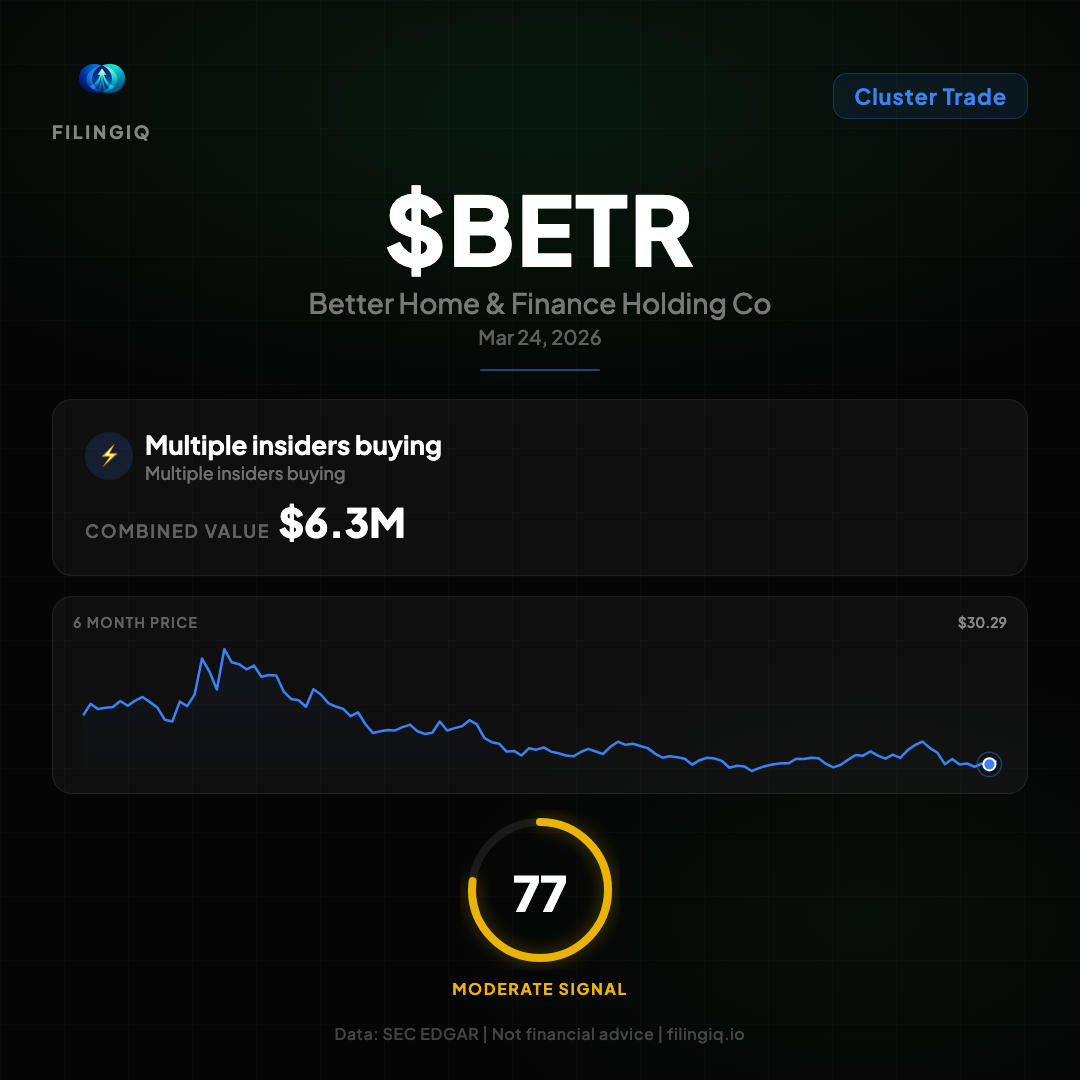
Better Home & Finance Insiders Just Bought $6.3M in Stock After a 70% Crash. Here's Why It Matters.
Better Home & Finance (NASDAQ: BETR) is down 70% from its September 2025 high of $94.06. The AI-powered mortgage lender went from $9.50 to $94 in six months, then gave back most of those gains in the following six. At around $29 a share, the stock sits well below its 200-day moving average and trades like a company with a credibility problem.
But two of the people closest to the business just spent over $6.3 million buying shares on the open market. Not exercising options. Not receiving grants. Writing personal checks.
Here is what the SEC filings show.
Framework Ventures: $5.65 Million Across Six Transactions
The largest buyer was Framework Ventures IV L.P., a crypto-native venture firm that took a 10% ownership stake in Better through a strategic deal announced in February 2026. But these open-market purchases are separate from that investment, they represent additional conviction, bought at market prices over a 15-day window as the stock dropped from $40 to $28.
| Date | Shares | Price/Share | Total |
|---|---|---|---|
| March 9 | 10,000 | $35.46 | $354,600 |
| March 11 | 21,598 | $39.73 | $858,088 |
| March 13 | 29,494 | $34.12 | $1,006,135 |
| March 16 | 25,000 | $29.55 | $738,750 |
| March 19 | 53,000 | $28.48 | $1,509,440 |
| March 23 | 40,000 | $29.60 | $1,184,000 |
| Total | 179,092 | ~$31.53 avg | ~$5,651,013 |
Framework bought the entire way down, starting at $35-40 per share in early March and continuing through the decline into the high $20s. The average purchase price of $31.53 means they are currently underwater on the earlier tranches, but they kept buying anyway. That is a pattern of accumulation, not a one-off trade.
CEO Vishal Garg: $619K in Personal Purchases
CEO Vishal Garg made five open-market purchases on March 23-24, totaling approximately $619,000 and 21,200 shares.
| Date | Shares | Avg Price | Total |
|---|---|---|---|
| March 23 | 750 | $28.50 | $21,375 |
| March 23 | 9,850 | $29.56 | $291,191 |
| March 24 | 6,701 | $28.37 | $190,133 |
| March 24 | 999 | $29.08 | $29,055 |
| March 24 | 2,900 | $30.06 | $87,175 |
| Total | 21,200 | ~$618,929 |
Before these purchases, Garg held 31,460 Class A shares. After, he held 52,660, a 67% increase in his position. This was personal capital deployed across a two-day window at prices roughly 70% below where the stock traded six months earlier.
The Counterpoint: COO Chad Smith Was Selling
Not everyone at Better was buying. COO Chad Smith sold 4,941 shares on March 16-17 for approximately $144,193 at prices around $28.51-$29.80. While the amount is small relative to the buying, it adds nuance. Insiders are not monolithic in their views, and one executive heading for the exit while others are doubling down is worth noting.
Combined Insider Buying: ~$6.27 Million
Adding Framework's $5.65 million and Garg's $619,000, total insider purchases came to approximately $6.27 million, roughly 1.4% of Better's $450 million market cap. That is a substantial concentration of insider capital deployed over a short window.
What Is Better Home & Finance?
Better is an AI-powered mortgage lender and fintech company founded in 2014, headquartered in New York. The company's core thesis is that it can use technology to make the mortgage process faster, cheaper, and more transparent than traditional lenders.
The key product is Tinman, a proprietary AI platform that automates the entire mortgage origination process, from point-of-sale through underwriting and closing. In Q4 2025, Tinman generated $646 million in funded volume, representing 44% of total volume. The full-year 2025 figure was 35% of volume, up from zero in 2024. Better is targeting 60% or more of volume through Tinman partnerships in 2026.
Better also launched a ChatGPT integration in Q1 2026 that delivers decision-ready credit outputs in 47 seconds and reduces origination timelines by an average of 21 days, with 95% instant underwriting capability. The company was the first fintech to fund more than $100 billion in cumulative mortgage volume.
Who Is Vishal Garg?
Garg is a polarizing figure in fintech. He grew up in Queens, attended NYU Stern, worked briefly at Salomon Brothers and Morgan Stanley, then quit on his 21st birthday to start his own ventures. He co-founded MyRichUncle, a student lending company that went public in 2005 and bankrupt in 2008. He founded Better in 2014 after his own frustrating mortgage experience, a Citibank loan that took 60 days to close.
But the defining moment of Garg's public reputation came on December 2, 2021, when he fired approximately 900 employees, 9% of the workforce, via a single Zoom call lasting about three minutes, just before the holidays. His exact words: "If you're on this call, you are part of the unlucky group that is being laid off. Your employment here is terminated effective immediately." He later accused laid-off employees of "stealing" by only working two hours a day, and a leaked internal email from 2020 revealed he had called employees "a bunch of DUMB DOLPHINS."
Three top communications executives resigned in protest. The board forced Garg to take a leave of absence. He returned as CEO in January 2022 after working with an executive coach.
His personal investment of $619,000 in BETR stock is notable precisely because of this history. It signals he is putting his own money where his mouth is, despite a reputation that still carries significant baggage. Whether you see it as conviction or as a redemption play, the fact that he nearly doubled his direct ownership stake at 52-week-adjacent lows is data worth considering.
Who Is Framework Ventures?
Framework Ventures is a crypto and web3 venture capital firm founded in 2019 by Vance Spencer and Michael Anderson. They were among the first VCs to go all-in on DeFi, with major early investments in Chainlink, Aave, Synthetix, and The Graph. They raised $400 million for their third fund in 2022.
Framework is not a typical passive investor in Better. Their relationship has two layers:
- A $45 million equity investment announced in February 2026, giving them approximately 10% ownership.
- A $500 million credit facility via the Sky stablecoin ecosystem, in which Better integrates into Sky through Obex, a Sky-focused incubator administered by Framework. The goal is to deploy stablecoin-backed capital into mortgage origination, potentially enabling sub-5% mortgage rates while the industry charges 6% or more.
The open-market purchases totaling $5.65 million are on top of this strategic investment. Framework is not just buying stock, they are building infrastructure around Better's mortgage business and then buying more equity at market prices as the stock declines. That suggests they view the current price as disconnected from the value of the partnership they are constructing.
Q4 2025 Earnings: Strong Numbers, Still Unprofitable
Better reported Q4 2025 results on March 13, 2026, and they were legitimately strong on the top line:
- Revenue: $44.31 million, up 77% year-over-year, beating estimates by $3.6 million
- Full year 2025 revenue: $165 million, up 52% YoY
- Q4 funded loan volume: $1.5 billion, up 56% YoY (vs. industry growth of 4%)
- Full year 2025 loan volume: $4.7 billion, up 32% YoY
- Net loss: $39.92 million (improved 33% from $59 million in Q4 2024)
- Loan contribution margin: ~$2,300/loan, up 28% from prior quarter
- Cash and equivalents: $229 million
The company guided Q1 2026 loan volume of $1.4-1.55 billion (70% YoY growth at midpoint), revenue of $53.9 million, and is targeting $1 billion in monthly loan volume by May 2026 and EBITDA breakeven by the end of Q3 2026.
Key partnerships driving the growth include Credit Karma (140 million+ members, less than 1% penetration so far), a top-5 non-bank originator (deployed to only 2% of 3,000+ loan officers), and the Framework/Sky stablecoin credit facility.
The Bull Case
- Scale of buying is meaningful. $6.27 million combined represents roughly 1.4% of the company's entire market cap, a level of insider commitment that goes well beyond symbolic gestures.
- The CEO is buying with personal money. Not options exercises or stock grants. Open-market purchases with personal capital, nearly doubling his position.
- Framework is a strategic partner, not just a stock buyer. They have a $500 million stablecoin credit facility deal in addition to their equity stake. Their continued open-market buying signals conviction in the partnership's value.
- The stock is 70% below its high. Insiders are buying into weakness, not chasing momentum.
- Fundamentals are inflecting. Revenue grew 77% in Q4. Losses are narrowing. The AI platform is scaling rapidly.
- Multiple catalysts ahead. $1 billion monthly volume target (May 2026), EBITDA breakeven (Q3 2026), Credit Karma scaling, stablecoin credit facility deployment.
- Analyst upside. The median price target is $40, representing roughly 38% upside from current levels. Cantor Fitzgerald upgraded to Strong Buy in January 2026.
The Bear Case
- Framework is not a typical insider. As a 10% owner from a recent strategic deal, their buying is partly strategic positioning, protecting and expanding an existing investment, not purely a stock conviction signal.
- The company is still deeply unprofitable. Q4 net loss was $40 million. They are forecasting another loss in Q1. Breakeven is a target, not a certainty.
- Short interest is extremely high. 2.0 million shares short, representing 16.9% of the float, up 1,167% over the past 12 months. The shorts are aggressively betting against this stock.
- The stablecoin and DeFi angle is unproven. Deploying stablecoin capital into mortgage origination sounds innovative, but it has never been done at scale. Traditional mortgage investors may view it skeptically.
- Garg's reputation is a liability. The Zoom layoff incident is not forgotten. Management risk is real.
- Extreme volatility. With a beta of 1.98, the stock has shown it can move 10x in one direction and give back 70% in the other, all within 18 months.
- Reverse stock split history. Better did a 1-for-50 reverse split in August 2024 to maintain its Nasdaq listing. That is typically a red flag for long-term value creation.
- Thin analyst coverage. Only one or two analysts actively cover the stock. The $40 price target may not be broadly representative.
The Bottom Line
When a CEO nearly doubles his personal stake at prices 70% below the 52-week high, and a strategic partner spends $5.65 million accumulating stock across six transactions over 15 days while the price falls, that is a data point worth paying attention to.
But this is not a simple story. The COO was selling. The short interest is surging. The company loses $40 million a quarter. The crypto-meets-mortgage thesis is novel but unproven. And the CEO's personal history adds a layer of complexity that cuts both ways.
The insiders have placed their bets. Whether they are right depends on execution, can Better reach EBITDA breakeven by Q3, scale the Tinman platform past 60% of volume, and prove that stablecoin-backed mortgage capital is more than a crypto gimmick? The next two quarters will tell the story.
For now, $6.3 million says the people closest to the business think the market has it wrong.
Want alerts on insider and congressional filings?
Create a free accountData: SEC EDGAR. Not financial advice.