4 Insiders Buy $2.9M in IPERIONX Ltd (IPX)
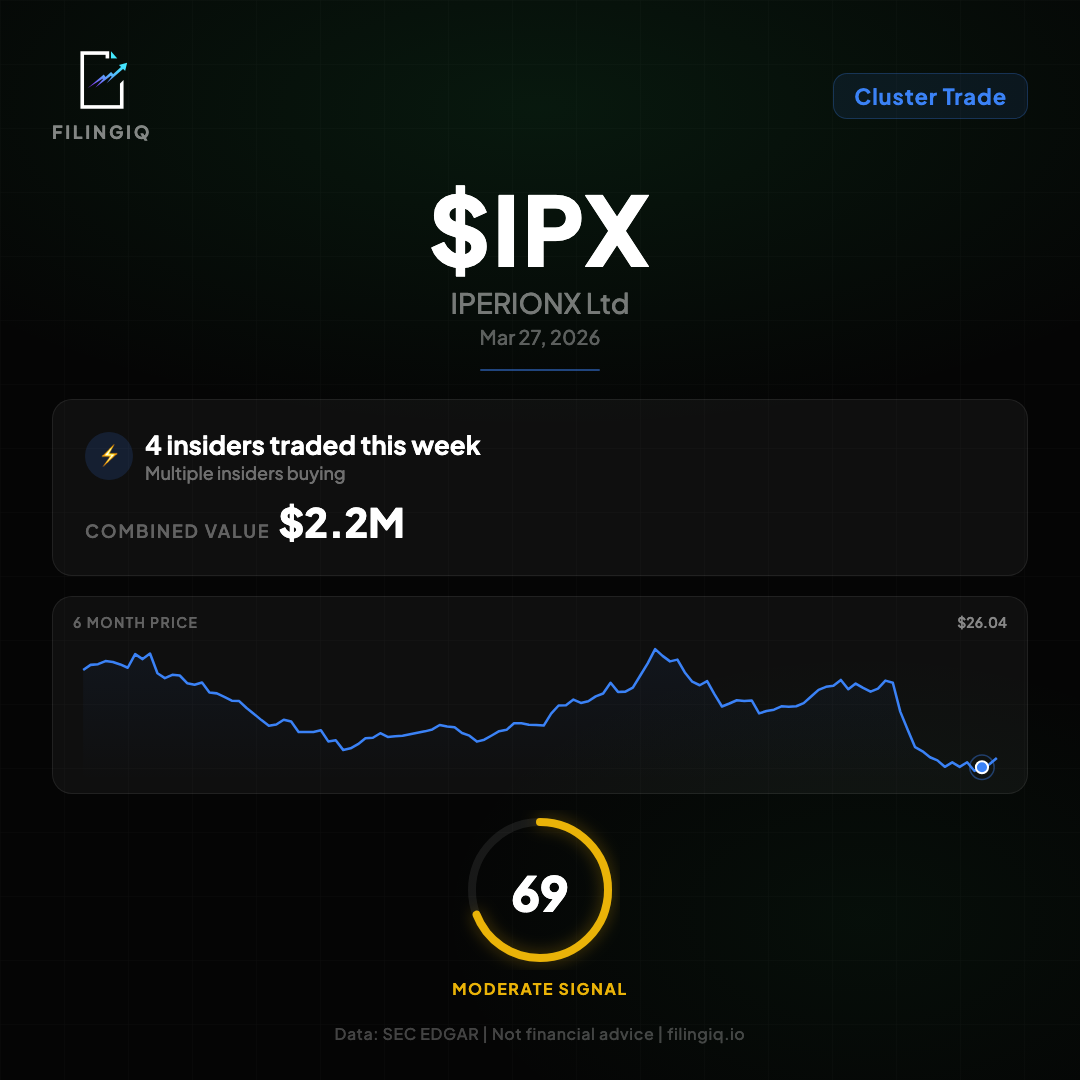
Four insiders at IperionX Limited (NASDAQ: IPX) collectively purchased more than $2.1 million in company stock on March 27, 2026, according to SEC Form 4 filings published on March 30. The buyers include the CEO, the Executive Chairman, the President, and a newly appointed board director. All four purchased on the same day. None of the transactions were made under pre-arranged 10b5-1 trading plans.
The purchases came less than two weeks after the stock lost roughly 42% of its value over three consecutive trading sessions, triggered by disappointing half-year financial results. At the time of the purchases, IPX was trading around $23 to $24 per ADS, approximately 60% below its 52-week high of $61.45.
The Transactions
IperionX is an Australian company dual-listed on the ASX (as IPX) and on the NASDAQ (as American Depositary Shares). One ADS represents ten ordinary shares. Some of these insider purchases were made on the ASX in Australian dollars, while others were made on the NASDAQ in US dollars. After currency conversion, the prices paid are roughly equivalent across both exchanges.
Anastasios "Taso" Arima, CEO and Managing Director, made the largest commitment. He purchased 467,000 ordinary shares on the ASX at A$3.198 per share and 12,800 ADS on the NASDAQ at $23.41 per ADS, for a combined total of approximately US$1.33 million. Arima already held over 11.7 million ordinary shares before this purchase, bringing his total to more than 12.2 million ordinary shares plus the 12,800 ADS. This is not a first-time buyer testing the waters. This is a CEO who already has significant skin in the game adding substantially more.
Todd Hannigan, Executive Chairman, purchased 225,225 ordinary shares on the ASX at A$3.20 per share, worth approximately US$498,000. Hannigan is a veteran natural resources executive with over 25 years of experience, including senior roles at BHP Billiton and Xstrata Coal. He holds an MBA from INSEAD and has helped build billion-dollar companies. Before this purchase, he already held over 25.4 million ordinary shares. His decision to add another quarter million shares into a 60% drawdown is a meaningful signal from someone with deep exposure to the company.
Toby Symonds, President, purchased 11,000 ADS at $23.87 per ADS for approximately US$263,000. This is notable because it appears to be his first open-market purchase of IperionX stock. He held zero ADS before this transaction. When a company president puts personal capital into company shares for the first time, it reflects something beyond routine confidence.
R. Tony Tripeny, Non-Executive Director, purchased 4,187 ADS at $23.76 per ADS for approximately US$99,000. Like Symonds, this was Tripeny's first open-market purchase. He held zero ADS before the filing. Tripeny is a significant appointment to the IperionX board. He spent 36 years at Corning Incorporated, the global leader in advanced materials science, where he rose to Executive Vice President and Chief Financial Officer before retiring in 2022. He was appointed to the IperionX board in March 2025. A former Fortune 500 CFO putting his own money into a pre-revenue titanium startup after spending a year on the board says something about what he has seen from the inside.
Total across all four insiders: approximately US$2.19 million.
What Does IperionX Actually Do?
IperionX is building a vertically integrated American titanium supply chain. The company uses two patented technologies, HAMR (Hydrogen Assisted Metallothermic Reduction) and HSPT (Hydrogen Sintering and Phase Transformation), to produce high-performance titanium metal from both recycled scrap and mined feedstock. The company claims these processes can achieve significantly lower costs than conventional titanium production methods.
The operational center is the Virginia Titanium Manufacturing Campus, where the company currently produces titanium metal powders and is working toward commercial-scale production. IperionX is planning a 7x capacity expansion to approximately 1,400 metric tons per year, with commissioning targeted for mid-2027.
Upstream, the company owns 100% of the Titan Critical Minerals Project in Tennessee, which contains resources of titanium, zircon, and rare earth minerals including dysprosium and terbium, elements critical for defense applications. The project is fully permitted and approaching a Definitive Feasibility Study expected in Q2 2026.
The company serves or is developing products for aerospace, defense, automotive, consumer electronics, medical, and energy markets.
Why the Stock Crashed
The insiders bought into a stock that had just experienced a brutal selloff. Here is the sequence of events.
In early to mid-March 2026, IperionX reported its half-year financial results for the six months ending December 31, 2025. The numbers were not encouraging in isolation: a net loss of US$34.8 million, more than double the US$16.2 million loss in the prior corresponding period. Loss per share widened from $0.06 to $0.10. Revenue remained at zero. R&D spending hit $10.8 million and capital expenditures reached $31.1 million.
The market reacted harshly. On March 12, the stock fell 14.4% in a single session. Over the following days, it continued lower, ultimately losing roughly 42% of its value over three trading sessions. Broader market conditions amplified the decline. Mid-March 2026 brought heightened volatility across both US and Australian markets, driven by geopolitical tensions and rising bond yields. Pre-revenue, capital-intensive companies like IperionX were among the hardest hit.
B. Riley Financial lowered its price target from $58 to $52 but maintained a "Buy" rating. As of the latest data, the consensus analyst rating remains "Strong Buy" from four covering analysts, with a mean price target of $55.33, implying over 100% upside from current levels.
The company ended the period with $65.8 million in cash and equivalents.
Government Backing and Defense Contracts
What makes IperionX different from a typical pre-revenue mining or materials story is the level of direct U.S. government involvement.
The company has received a cumulative $47.1 million in funding from the U.S. Department of Defense through its Industrial Base Analysis and Sustainment (IBAS) program. This funding is specifically intended to strengthen the domestic titanium supply chain, a strategic priority given that global titanium supply is heavily concentrated in Russia and China.
In January 2026, IperionX received a prototype purchase order from American Rheinmetall, a defense contractor, for 700 titanium track pin components for U.S. Army heavy ground combat systems. The order was valued at $300,000 and calls for delivery within 8 to 9 months. The titanium components are produced from 100% recycled feedstock using IperionX's technologies and are expected to reduce component weight by 40 to 45% compared to steel equivalents. The company has indicated this initial order could lead to significantly larger agreements upon successful delivery.
Also in January 2026, IperionX received the final $4.6 million installment of its Department of War funding along with 290 metric tons of titanium scrap from the U.S. government for use as recycled feedstock.
The Board
The caliber of IperionX's board adds context to why this cluster purchase is worth attention. Beyond the four insiders who purchased stock:
Lorraine Martin, Lead Independent Director, spent 35 years at Lockheed Martin, rising to Executive Vice President where she led 34,000 global employees across multiple countries and oversaw the integration of Sikorsky helicopter operations.
Beverly Wyse, Non-Executive Director, has over 30 years of senior leadership at Boeing, including serving as Vice President and General Manager of Boeing South Carolina.
Melissa Waller, Non-Executive Director, is the former Deputy Treasurer and Chief of Staff for the North Carolina Department of State Treasury, where she oversaw pension systems managing $90 billion in assets.
This is not a typical small-cap board. The concentration of senior defense and aerospace veterans suggests real industry connectivity, not just governance window dressing.
CEO Taso Arima also has a track record worth noting. He is the founder of Piedmont Lithium (NASDAQ: PLL), which he built from an early-stage exploration company to a NASDAQ-listed lithium producer. He has experience taking critical mineral companies from exploration through to commercialization.
The Bull Case
Several factors support a constructive outlook on these insider purchases:
Genuine conviction from multiple levels of leadership. Four insiders buying on the same day with no pre-arranged trading plans is statistically uncommon. Two of the buyers, the President and a director, were making their first personal purchases ever. The CEO and Chairman, who already hold massive positions, added more.
Strategic tailwinds. Domestic titanium production is a stated U.S. government priority. IperionX is one of a very small number of companies positioned to serve this need. The $47 million in government funding and the U.S. Army prototype order provide validation from the highest levels.
Technology differentiation. The company's patented HAMR and HSPT processes allow production from recycled titanium scrap, a unique positioning that reduces both cost and dependence on mined feedstock.
Analyst consensus. Four analysts maintain a "Strong Buy" rating with a mean target of $55.33, more than double the current price.
Board quality. Former senior leaders from Lockheed Martin, Boeing, Corning, and the North Carolina Treasury do not typically join the boards of companies they view as speculative gambles.
Approaching commercial inflection. IperionX's 2026 shareholder letter targets progressively scaling titanium manufacturing sales through 2026, with a positive EBITDA inflection point projected by year-end 2026.
The Bear Case
There are real risks that investors should weigh:
Pre-revenue with growing losses. IperionX generated zero revenue in the most recent reporting period while spending $34.8 million. The loss more than doubled year over year. The path to profitability requires significant execution.
Capital intensity. The planned 7x expansion to 1,400 tpa at the Virginia campus will require substantial additional capital. With $65.8 million in cash and a $34.8 million half-year burn rate, the runway is limited without additional funding or revenue.
Execution risk. Moving from prototype production to commercial-scale manufacturing is the hardest transition in materials science. Many companies with promising lab results fail to achieve reliable, cost-competitive production at scale.
Valuation. An $818 million market cap for a company with no revenue is pricing in significant future success. If the commercialization timeline slips, the market may lose patience.
Small initial contracts. The $300,000 Army prototype order, while symbolically important, is tiny in absolute terms. Larger production contracts have not yet materialized.
Dilution risk. Pre-revenue companies frequently raise capital through secondary offerings. With 339 million shares outstanding, additional issuance could dilute existing shareholders.
What to Watch
The near-term signals that will clarify whether these insider purchases were well-timed:
The Q2 2026 Definitive Feasibility Study for the Titan project in Tennessee. A strong DFS could de-risk the upstream feedstock story significantly.
Progress on commercial orders beyond the initial Rheinmetall prototype. Conversion from prototype to production contract would be a major catalyst.
The EBITDA inflection point that management has targeted for year-end 2026. Any signs of revenue traction from the Virginia campus will be closely watched.
Whether additional insiders follow with purchases, or whether this cluster stands alone. A second wave of buying would reinforce conviction. Silence might suggest the window of confidence was bounded.
The next earnings report is scheduled for June 9, 2026.
Want alerts on insider and congressional filings?
Create a free accountData: SEC EDGAR. Not financial advice.