Grocery Outlet Insiders Buy $6.3M in Stock After 70% Crash
Grocery Outlet Insiders Just Bought $6.3 Million in Stock After a 70% Crash. Here's Why It Matters.
Grocery Outlet (NASDAQ: GO) stock has been in freefall. Down 70% from its September 2025 high of $19.41, battered by a catastrophic Q4 earnings miss, 36 store closures, and multiple securities fraud lawsuits, this is not the kind of stock most people are rushing to buy.
But the people who run the company? They're buying aggressively.
In just two weeks, six Grocery Outlet insiders, including the CEO, the chairman, and four directors, spent over $6.3 million of their own money buying shares at prices near the 52-week low. That's not a routine compliance gesture. That's a coordinated bet that the market has overreacted.
The CEO's $1.7 Million Purchase
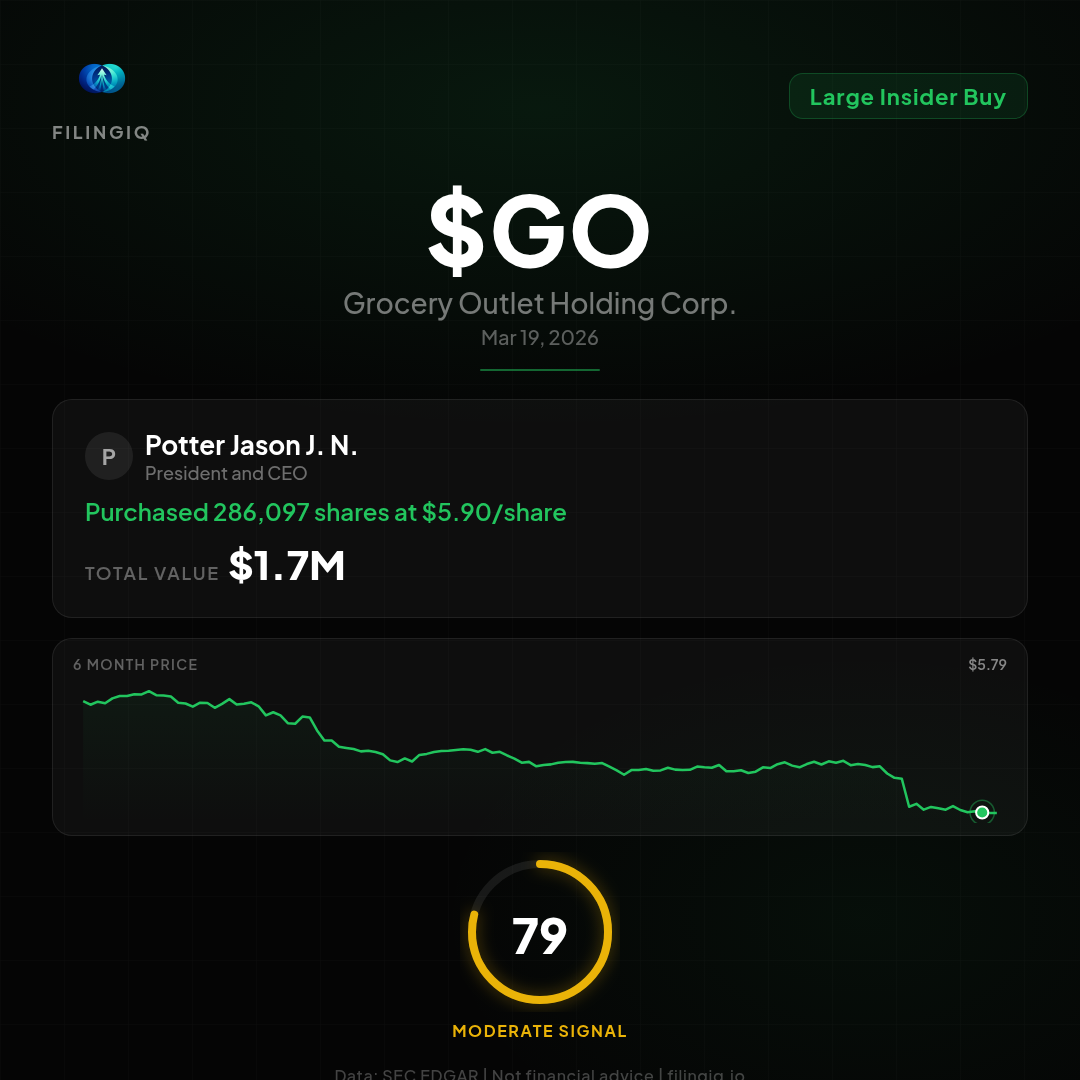
The headline transaction came from President and CEO Jason Potter. On March 19, he bought 286,097 shares at $5.90 per share, totaling $1,687,972 in personal capital.
What makes this even more striking is the sequence of events. Earlier in March, Potter received RSU grants that vested as part of his compensation package, and he sold 67,397 shares on March 9, likely to cover the tax obligation. Ten days later, he turned around and bought 286,097 shares on the open market. He bought back 4.2 times what he sold.
Before this purchase, Potter held roughly 288,000 shares. After it, he held 574,366. He nearly doubled his entire position in the company he runs, at a price 70% below where the stock traded six months ago.
He Wasn't Alone
Potter's purchase was the largest single transaction, but it was part of a much broader wave of insider buying:
| Insider | Role | Shares Bought | Amount |
|---|---|---|---|
| Jason Potter | President & CEO | 286,097 | $1.69M |
| Eric Lindberg Jr. | Chairman / Director | 275,000 | $1.64M |
| Erik Ragatz | Director | 325,000 | $1.94M |
| Jeffrey York | Director | 120,000 | $698K |
| Carey Jaros | Director | 40,000 | $250K |
| John Bachman | Director | 16,000 | $103K |
That's six insiders, over one million shares, and $6.3 million in total purchases, all within a two-week window following the March 5 stock crash. Cluster buying at this scale, especially when it includes the CEO and chairman, is one of the strongest signals in insider trading analysis.
Meanwhile, the only sales during this period were small transactions tied to RSU vesting tax obligations, the kind of routine dispositions that carry no bearish signal.
What Caused the Crash
To understand why insiders are buying, you need to understand what went wrong.
On March 4, 2026, Grocery Outlet reported Q4 and full-year fiscal 2025 results that shocked the market. The stock dropped 28% the next day.
The numbers were ugly. The company reported a GAAP net loss of $224.9 million for the full year, compared to a $39.5 million profit the year before. That loss was driven by $149 million in goodwill impairment charges, $113.8 million in long-lived asset impairments, and $45.9 million in restructuring costs. The company announced it would close 36 underperforming stores, with 24 of them on the East Coast.
On top of that, fiscal 2026 guidance came in well below expectations. The company projected adjusted EPS of roughly $0.50 at the midpoint, 38.6% below what analysts had been expecting. Comparable store sales guidance ranged from -2% to flat.
The market's reaction was swift and severe. Multiple analysts downgraded the stock. Jefferies cut its target from $18 to $7. Wells Fargo dropped from Overweight to Equal-Weight. Goldman Sachs maintained its Sell rating. And several law firms filed securities fraud class action lawsuits alleging the company had misled investors about the impact of its rapid expansion.
The Bull Case: Why Insiders Might Be Right
Here's the thing about all that bad news: the market knows. It's priced into a stock that's lost 70% of its value. The question insiders seem to be answering with their wallets is whether the market has gone too far.
At current prices, Grocery Outlet trades at roughly 4.5x EV/EBITDA. The sector average is 11.2x. The company's own three-year median is 12.3x. That means the stock would need to nearly triple just to trade in line with its historical valuation, let alone its peers.
The company still does $4.69 billion in annual revenue. It generated $254 million in adjusted EBITDA last year. The business model, buying surplus inventory from major brands at steep discounts and selling through independently operated stores, creates a natural moat. Grocery Outlet pays 40-70% below conventional wholesale prices, and its independent operator model means each store is run by an owner with skin in the game.
The 36 store closures, while painful, are concentrated in the East Coast markets where the company expanded too aggressively. CEO Potter, who was recruited from The Fresh Market where he led a successful turnaround, has essentially acknowledged the over-expansion and is pruning back to focus on the company's core Western U.S. markets.
There's also a broader tailwind. Discount grocery is the fastest-growing segment in the industry, projected to grow at 4.8% annually through 2030. Consumers are increasingly value-conscious, 70% report being "extremely or very concerned" about grocery prices. If tariff-driven inflation pushes food prices higher in 2026, as many economists expect, Grocery Outlet's value proposition only gets stronger.
The Bear Case: What Could Go Wrong
Insiders aren't infallible. The securities fraud lawsuits, while common after sharp stock declines, do add uncertainty. The East Coast expansion was a strategic misstep that will take time and capital to unwind. And the competitive threat from Aldi, which is opening 180+ U.S. stores in 2026 alone, is real and growing.
Comparable store sales turning negative is a concern. If the company can't stabilize comps, the turnaround thesis weakens regardless of how cheap the stock looks on paper.
There's also the question of whether the impairment charges are truly one-time or the beginning of a longer write-down cycle as the company evaluates its remaining store portfolio.
What Our Data Shows
FilingIQ's composite scoring system rated Potter's purchase a 79 out of 100, classified as a "Very High Conviction Buy." The conviction dimension scored a perfect 100, driven by the dollar value of the purchase, the size relative to his existing holdings, and the cluster of other insider buying happening simultaneously.
The Bottom Line
When a CEO nearly doubles his position in his own company two weeks after the stock crashes 28%, and five other insiders collectively put $4.6 million more on the table, it tells you something about what the people closest to the business think it's worth.
They're not buying because the stock is popular. They're buying because it isn't.
Whether they're right will depend on execution: can Potter stabilize comparable store sales, successfully close underperforming locations without operational disruption, and refocus the business on the markets where Grocery Outlet's opportunistic buying model works best? The next earnings report (expected May 5, 2026) will be the first real test of the turnaround plan.
For now, the insiders have placed their bets. Six people who see the company's books every quarter just spent $6.3 million saying the market has it wrong.
Want alerts on insider and congressional filings?
Create a free accountData: SEC EDGAR. Not financial advice.